A Sculptural Study of Mental Transmission
Curatorial Summary – Second Signal
Second Signal continues the conceptual trajectory of Red Senses, shifting focus from perception to the execution of action. Anne Felicie Nickels explores how processed thoughts transform into movement via a circular opaline transmitter linked to an arm and hand.
The transmitter’s black-and-white static pattern evokes mental interference—unresolved thoughts that loop and resist closure. White signals spread through a tangle network, interpreted as cognitive anchors, while a finer “Second Signal” of black noise travels through graphic lines to the hand.
Colors respond dynamically: red and blue represent emotional extremes, violet their blend, and orange signals disengagement. The hand’s upward gesture, paired with contrasting textures—glossy front, matte back—highlights the duality of action: conscious intention vs. hidden hesitation. Second Signal reveals action as both physical and deeply encoded.
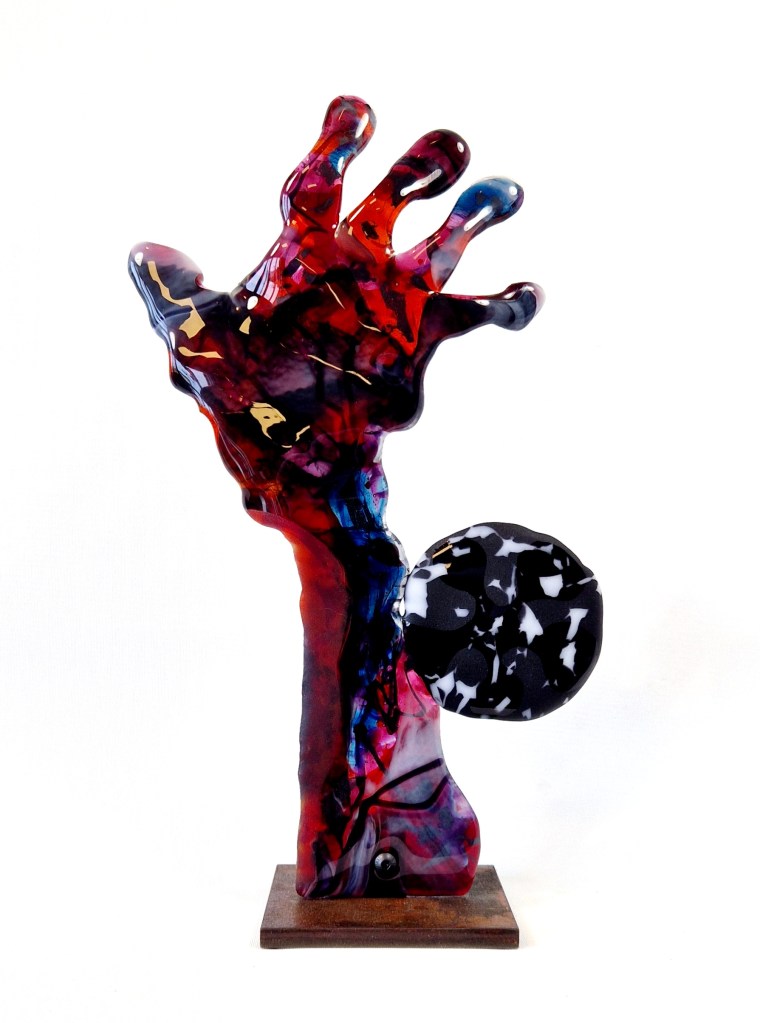
Second Signal – Frontal View This image presents the complete sculpture Second Signal viewed from the front. The hand reaches upward, balanced on a solid iron plate that anchors the work. Despite its vertical gesture and outward movement, the glass structure appears to sag slightly—creating a visual tension between ascent and gravitational pull. This contradiction highlights the emotional weight inherent in acts of will and expression.

Second Signal – Transmitter Detail This close-up shows the transmitter where internal signals originate. A raised form on the surface echoes the cerebellum from Red Senses, linking thought and action. White static emerges from black noise, with a fine graphic line extending outward—representing the transformation of thought into directed impulse.

Second Signal – Surface and Signal Points Seen from above, this view reveals the sculpture’s textured backside, a characteristic feature in Anne Felicie Nickels’ work. The subtle surface relief contrasts with the glossy front, emphasizing the duality of visible action versus hidden structure. Notably, this angle reveals blue signal coding: one point on the tip of the ring finger and another at the middle joint of the index finger. These isolated nodes suggest points of internal regulation—cool, restrained areas in a composition otherwise charged with emotional energy.
Svenska
Vetenskaplig beskrivning av verket Second Signal
Second Signal är en fortsättning på Red Senses och modellerar den fas där bearbetade intryck omvandlas till handling. Verket visualiserar hur signaler från kognitiv bearbetning överförs till motorisk aktivitet genom en cirkulär sändarenhet som kopplas till en arm med hand.
Den centrala sändaren utgörs av en opaliserande cirkulär skiva, vars yta präglas av ett distinkt svartvitt brusmönster. Den vita komponenten förgrenar sig via ett nätverk av tanglier som löper genom armens baksida. Dessa strukturer, utförda i matt relief, fungerar som spridningspunkter. Även om tangliernas exakta funktion inte är fullt klarlagd, tolkas de här som kognitiva förbindelselänkar. Det vita – som i föregående verk symboliserade förnekelse – föreslås i detta sammanhang representera mentala bindningar, vilka stabiliseras genom den friktion som uppstår när obearbetade tankar upprepas och kvarstår i medvetandet.
Den primära signalen, benämnd svart brus, har en finare, mer linjär struktur. Genom ett system av grafiska linjer fördelas denna signal – den så kallade andra signalen – vidare till hela handen. Inom handens struktur aktiveras färgzoner som svar på signalens innehåll, på liknande sätt som hos en kameleontliknande färgreglering. Systemet kan snabbt anpassa sig till omgivningen, alternativt “frysas” och bevaras för återanvändning vid liknande omständigheter.
Verket arbetar med ett begränsat men uttrycksfullt färgspektrum:
- Rött och blått fungerar som grundfärger – motsatser i spektrumet för värme och kyla. När de blandas uppstår violett, i varierande intensitet och nyans.
- Orange, som röd nyans utan blått, representerar lägre engagemang.
Färgdistributionen i skulpturen följer en logisk fördelning:
- Blå toner koncentreras i området strax ovanför sändaren, där signalen först överförs. Dessa övergår successivt till djupvioletta nyanser i handflatan och återfinns endast som punktuella beröringszoner ytterst i två av fingrarna.
- Röda och orangea toner är mest framträdande runt knogar, tumme och handled, vilket tolkas som uttryck för värme och friktion kopplad till osäkerhet eller beslutssituationer.
Den gestiska utformningen – en uppåtsträckt hand med lätt böjda fingrar – i kombination med ytkontrasten mellan glansig framsida och matt relief på baksidan, förstärker verkets tematik kring den dubbla naturen i mänsklig handling: den synliga viljan kontra den inre motståndskraften och tvekan.
Scientific Description of the Artwork Second Signal
Second Signal is a continuation of Red Senses and models the phase in which processed impressions are converted into action. The work visualizes how signals from cognitive processing are transferred into motor activity via a circular transmitter connected to an arm with a hand.
The central transmitter consists of an opaline circular disc, its surface marked by a distinctive black-and-white static pattern. The white component branches into a network of tanglers connected through the back side of the arm. These structures, integrated into a matte relief, function as a network of anchoring points. While the exact function of these tanglers remains undetermined, they are here interpreted as cognitive linkages. The white—previously symbolizing denial in Red Senses—is in this context proposed to represent mental bindings, stabilized through the charge generated by repetitive, unresolved thoughts that persist in consciousness.
The signal that directly initiates action, referred to as black noise, has a finer, more fluid structure. Through a system of graphical lines, this signal—the so-called Second Signal—is transmitted throughout the hand. Within the structure of the hand, color zones are activated in response to the signal’s content, similar to chameleon-like color modulation. This system can quickly adapt to its environment or, alternatively, be “frozen” and stored for future activation under similar conditions.
The work operates within a limited but expressive color spectrum:
- Red and blue serve as primary oppositional hues—symbolizing warmth and coldness. When combined, they produce violet, in varying intensities and shades.
- Orange, a red hue lacking blue, represents reduced engagement or lower emotional intensity.
The distribution of color across the sculpture follows a structured logic:
- Blue tones act as a buffer, concentrated just above the transmitter, where signal transfer begins. Pure blue gradually shifts into deeper violet across the palm and appears only in isolated, point-like contact zones in two of the fingers.
- Red and orange tones dominate the areas around the knuckles, thumb, and wrist, interpreted as manifestations of heat through friction, often associated with uncertainty or moments of decision.
The gesture of the sculpture—an upward-reaching hand with slightly bent fingers—combined with the textural contrast between a glossy front and a matte-relief back, reinforces the artwork’s exploration of the dual nature of human action: the visible will versus the inner resistance and hesitation.
 ARTworks by Anne Felicie Nickels
Leave a comment