Glass-Based Simulation of Cognitive Defense Under Affective Stress
Preface
In Red Senses, Anne Felicie Nickels constructs a conceptual glass model in which perception meets affective stress within a kind of inner anatomy. The sculpture is both body and thought— a transparent map of how sensory input is filtered, distorted, and transformed into behavior and defense. It leads us into that silent zone where experiences haven’t yet become language, but the body has already reacted. Here, our responses to discomfort, moral dissonance, or psychological overload begin to take form.
With her choice of material—Bullseye glass in varying degrees of opacity, transparency, and color—Nickels doesn’t just suggest a state of mind, but a dynamic: how perception activates emotion, how emotion demands regulation, and how regulation in turn shapes the self. The work is marked by psychological, neuroethical, and existential undertones, yet remains deeply human in its expression.
At the heart of the sculpture lies a question: how do we endure what threatens to undo us? The red tones signal danger—an alert that inner stability is under threat. But beneath the surface, other forces are at work: denial, idealization, conscience, and the longing for beauty. Red Senses doesn’t offer resolution. It presents a condition—an in-between space where body, mind, and soul are forced into dialogue, often tense, sometimes reconciliatory.
Svenska
Vetenskaplig beskrivning av verket Red Senses – ett modellförslag för perceptionens och egots inre arkitektur
Verket Red Senses kan förstås som en symbolisk modell över människans sensoriska och psykologiska processer, visualiserad genom skulptur i lager av glas. Skulpturen fungerar som en fiktiv anatomisk och neuropsykologisk studie där sinnesintryckens väg genom kroppen analyseras.
Sensorisk mottagning och nedåtgående fördelning
Ytterst registreras stimuli via syn, hörsel och lukt, representerade av fragmenterade sensoriska organ i verket – ett öga, ett öra och en näsa. Dessa är utförda i rött, ett spektrum som signalerar alarm, smärta och obehag, och därmed även aktivering av kroppens affektiva responssystem.
Intrycken kanaliseras nedåt genom ett system av interna ledningsbanor – abstraherade som glaslager – där informationen leds genom ett komplext filter av känslor och subjektiva tolkningar. I verkets bas sker en transformation via en opaliserande brygga. Denna brygga fungerar som ett imaginärt plexus där perception övergår till kognition, och där informationen bryts, förvrängs och kodas om.
Ryggraden – den moraliska och kognitiva axeln
Från denna brygga övergår flödet till en ryggrad uppbyggd av block med varierande glasstruktur och färg. Ryggraden representerar ett slags exekutivt kontrollcentrum, där val och beteenden formas.
- Vitt opalt glas symboliserar förnekelse: ett tillstånd av kognitiv blockering och skyddsmekanism. Ljuset stannar vid ytan, absorberas utan transparens – analogt med hur vi undviker att se det vi inte orkar bearbeta.
- Guld, ett material traditionellt förknippat med ädelhet, genomlyses i verket och avslöjar sin skugga: det övergår gradvis till svart transparent glas, vilket visualiserar moralisk dubbelhet och svek mot ideal.
Tillsammans bildar de två materialen en dubbelsidig ryggrad där det vi uppfattar som ädelt ofta samexisterar med dess mörka motsats.
Ryggraden fungerar också som en bana för egots rörelse – upp och ned – i en ständig pendling mellan självförverkligande och självbedrägeri.
Lillhjärnan – koordinationsnod och sil för baktankar
På sidan av ryggraden, halvvägs upp, är lillhjärnan placerad. Denna nod har både en biologisk och symbolisk funktion. I verkets modell fungerar den som ett filtreringssystem för undermedvetna motiv – där baktankar, sociala masker och emotionella impulser silas. Koordinationen som sker här är inte fysisk, utan etisk och emotionell.
Den är innesluten i blå och violetta toner, färgskalor som här förknippas med både samvetet och skönhetens lockelse. Hur dessa färger interagerar är oklart – men i vissa nyanser tycks en form av godhet träda fram, som en belöningssignal för moraliskt riktad perception. Detta subtila ljusspel antyder en koppling till de punktvisa ansamlingarna i hjärnbarken högst upp i verket, där spår av samvete framträder som isolerade men aktiva noder.
Hjärnmassan – själens boning och kognitivt töcken
Överst i skulpturen ligger hjärnan, modellerad som en grumlig opaliserande massa där vitt, grått och svart virvlar samman. Detta är ingen plats för logik eller klarhet, utan en tät atmosfär av oklara impulser, förlorad riktning och svikna ideal. Det är här själen sägs bo – inte som något sublimt och ljusfyllt, utan som en del av detta komplexa inre landskap.
Punktvisa ansamlingar av samvete kan observeras i hjärnbarken – spår av något oförstört, en rest av intention och inre kompass. De förblir isolerade men antyder att en återkoppling till moralisk integritet är möjlig, även i ett system präglat av splittring.
Öga och filtrering
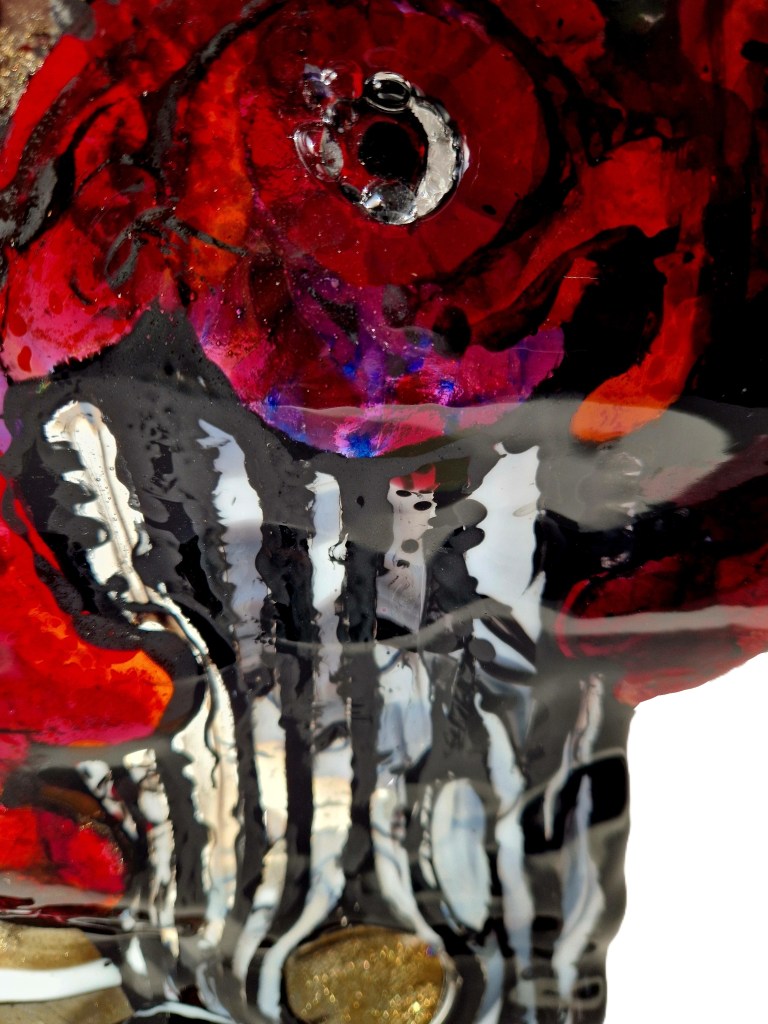
Ögat och glasbanor som leder sinnesintryck nedåt.

Brygga och lillhjärna
Bryggan till ryggraden och lillhjärnans anslutning.
Samvete och blick
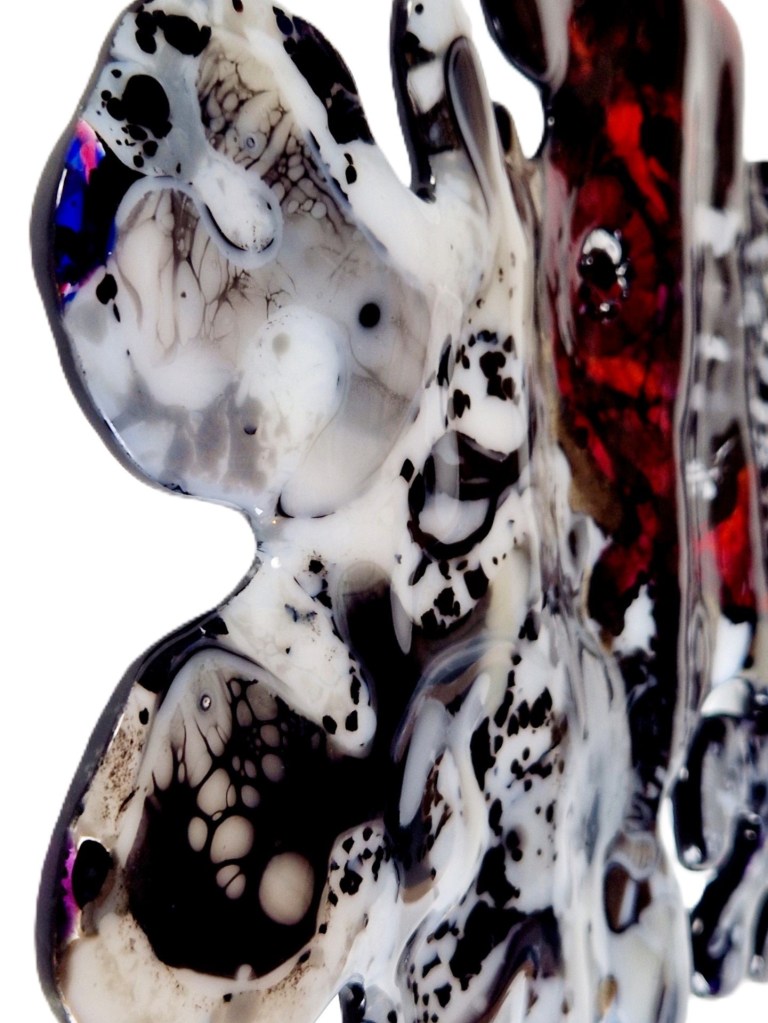
Vy uppifrån: ögats riktning mot blå samvetspunkt i yttre hjärnbarken.
Scientific Description of the Artwork Red Senses – A Model Proposal for the Inner Architecture of Perception and the Ego
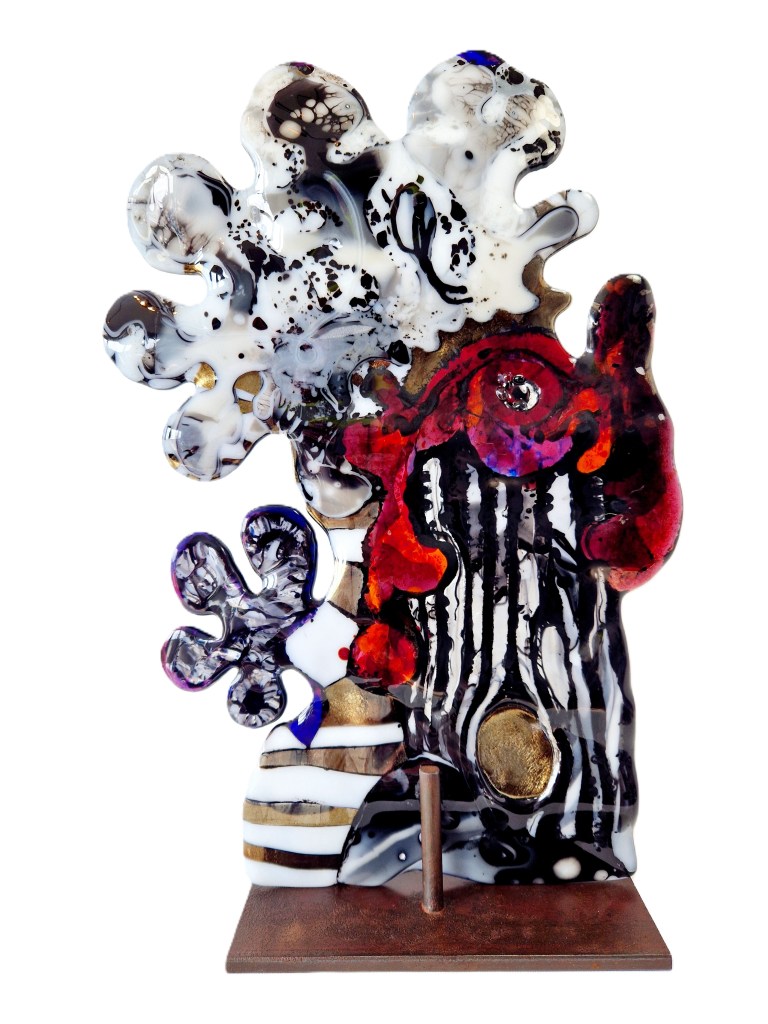
The artwork Red Senses can be interpreted as a symbolic model of human sensory and psychological processes, visualized through a sculpture composed of layered glass. The sculpture functions as a fictional anatomical and neuropsychological study, analyzing the path of sensory impressions as they move through the body.
Sensory Reception and Downward Distribution
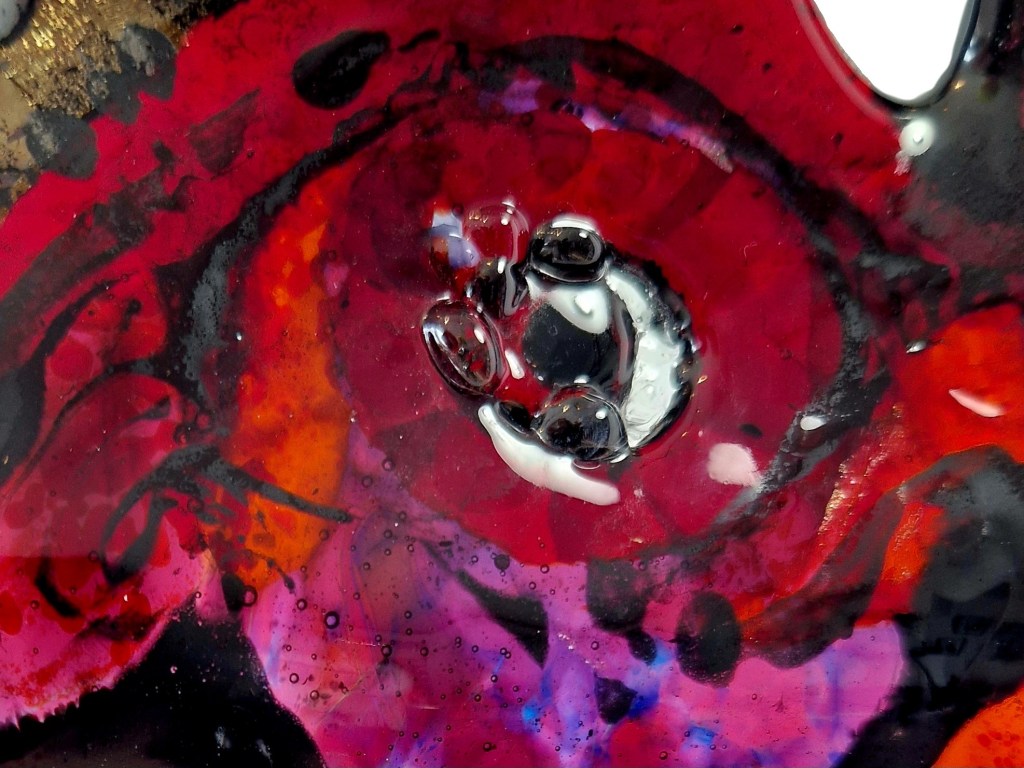
At the outermost level, stimuli are received through sight, hearing, and smell—represented in the artwork by fragmented sensory organs: an eye, an ear, and a nose. These are rendered in red, a color spectrum that signals alarm, pain, and discomfort, thereby activating the body’s affective response system.
The impressions are channeled downward through a system of internal conduits—abstracted as layers of glass—where information is filtered through complex layers of emotion and subjective interpretation. At the base of the sculpture, a transformation occurs via an opaline bridge. This bridge functions as an imagined plexus where perception transitions into cognition, and where the information is refracted, distorted, and re-encoded.

The Spine – The Moral and Cognitive Axis
From this bridge, the flow continues into a spine composed of blocks with varying glass structures and colors. The spine represents an executive control center, where decisions and behaviors are formed.
- White opal glass symbolizes denial: a state of cognitive blockage and protective mechanism. Light is halted at the surface, absorbed without transparency—an analogue for how we avoid confronting what we cannot bear to process.
- Gold, traditionally associated with nobility, is illuminated in the sculpture to reveal its shadow: it gradually transitions into black transparent glass, visualizing moral duality and the betrayal of ideals.
Together, these two materials form a dual-sided spine, where what we perceive as noble often coexists with its darker counterpart. The spine also acts as the pathway for the ego’s movement—up and down—in a constant oscillation between self-realization and self-deception.

The Cerebellum – Coordination Node and Filter for Hidden Motives
Positioned to the side of the spine, halfway up, lies the cerebellum. This node has both a biological and symbolic function. In the model, it serves as a filtering system for subconscious motives—where hidden agendas, social facades, and emotional impulses are sifted. The coordination that occurs here is not physical, but ethical and emotional.
It is enclosed in blue and violet tones, color scales associated here with conscience and the allure of beauty. How these colors interact is unclear—but in certain shades, a form of goodness appears to emerge, like a reward signal for morally directed perception. This subtle play of light suggests a connection to the small, localized clusters in the upper brain, where traces of conscience are visible as isolated yet active nodes.
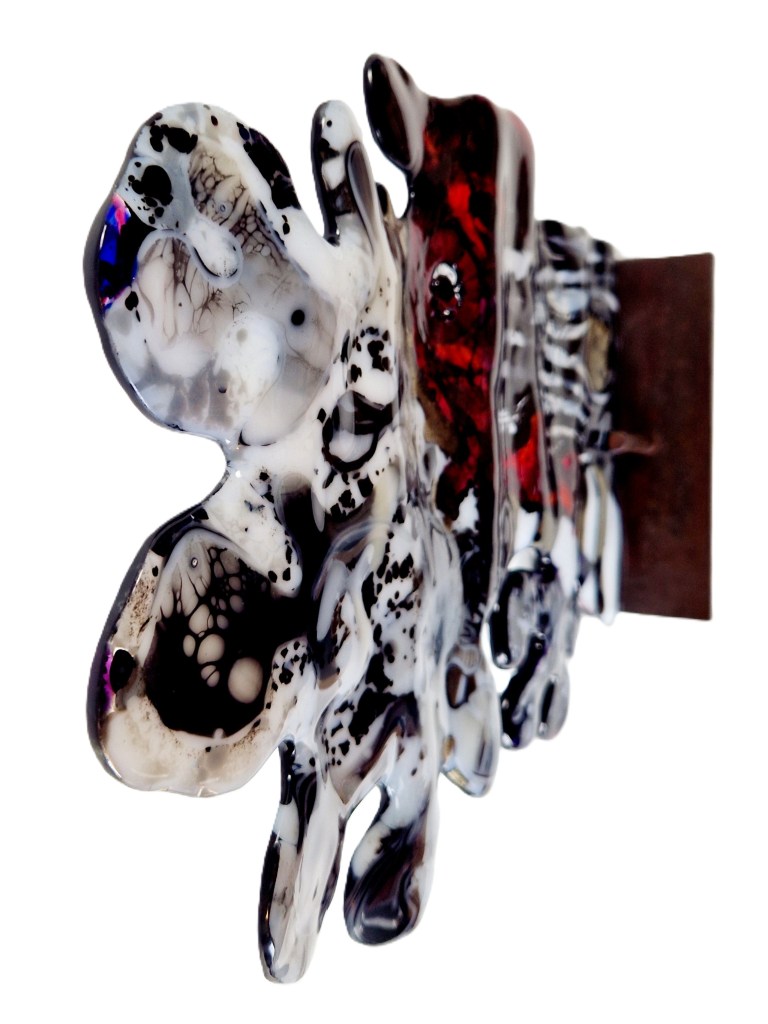
The Brain Mass – Seat of the Soul and Cognitive Fog
At the top of the sculpture lies the brain, modeled as a cloudy, opaline mass where white, grey, and black swirl together. This is not a place of logic or clarity, but a dense atmosphere of murky impulses, lost direction, and betrayed ideals. It is here that the soul is said to reside—not as something sublime or filled with light, but as part of this complex inner landscape.
Scattered clusters of conscience can be observed in the cerebral cortex—traces of something unbroken, a remnant of intention and inner compass. These remain isolated, but suggest that a reconnection to moral integrity is possible, even within a system shaped by internal fragmentation.
Image 1: Overview of the entire piece. Image 2: Detail of the central bridge base between glass filter channels and spinal building blocks. Image 3: The cerebellum’s membrane and inner lamellae. Image 4: Top view with eye and cortical conscience points.

Leave a comment